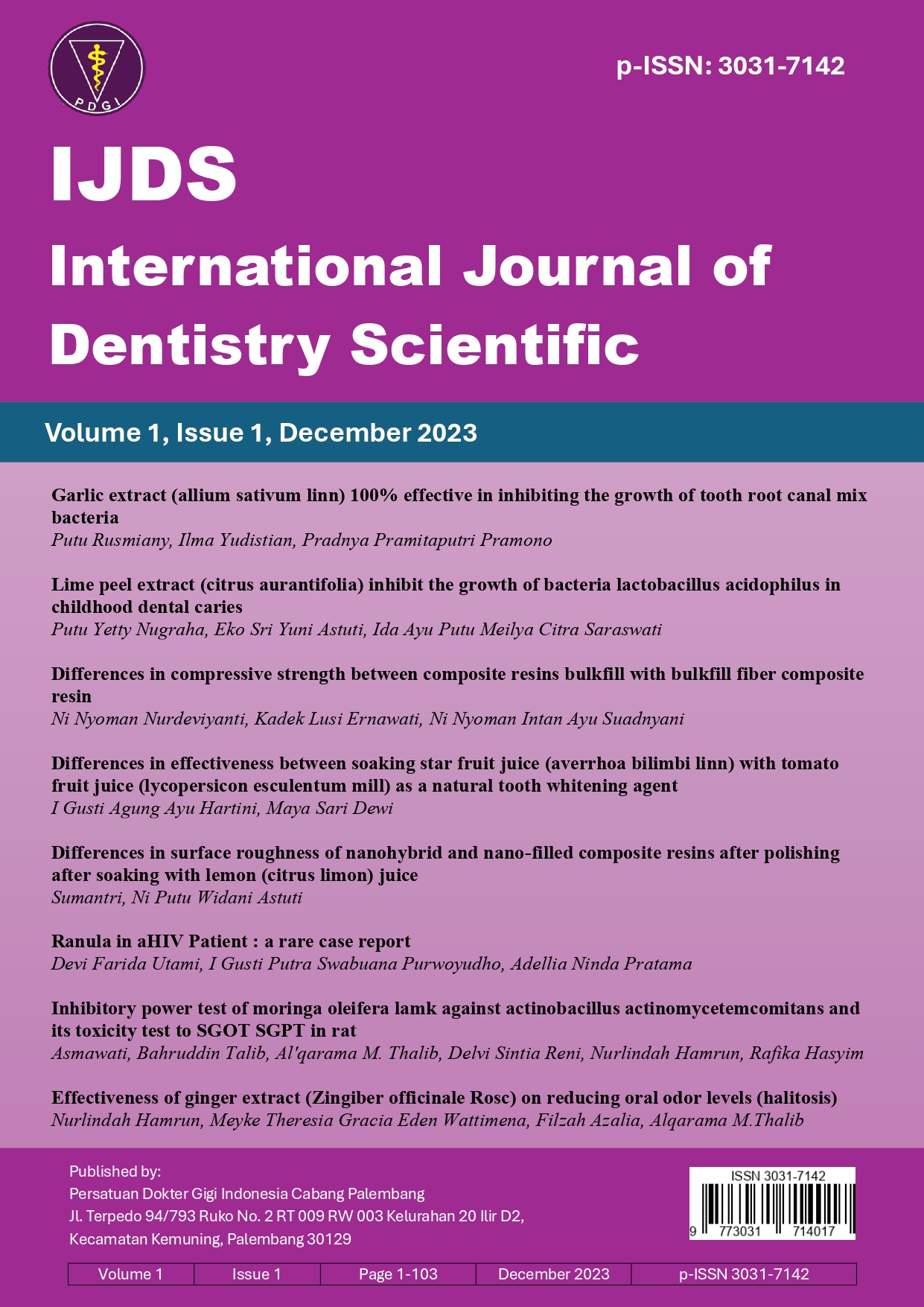
Effectiveness of ginger extract (Zingiber officinale Rosc) on reducing oral odor levels (Halitosis)
Keywords:
Halitosis, Oral Odor, Ginger (zingiber officinale Rosc.)Abstract
Bad breath (halitosis) is a common problem that often results from the decaying action of microorganisms on endogenous or exogenous proteins and peptides. Some factors that cause bad breath (halitosis) are smoking, alcohol consumption, diabetes, obesity, and periodontal disease. Ginger (Zingiber officinale Rosc.) is one of Indonesia's medicinal commodities and spices included in traditional medicine. Ginger contains compounds such as antimicrobials from the phenol group, flavonoids, terpenoids, and essential oils, a class of bioactive compounds that ginger can inhibit microbial growth. To determine the role of ginger extract (Zingiber officinale Rosc.) in reducing halitosis levels in Hasanuddin University dental students in Makassar City, South Sulawesi. The design of the research is Experimental. This research obtained a sample of 45 respondents. Data collection using Consecutive Sampling. Data processing and analysis techniques were performed with the Independent Sample T Test. The results showed a significant difference in halitosis values between before and after gargling with 2%, 4%, and 6% ginger concentration solutions; the most effective concentration to reduce halitosis levels was 6% (p<0.05). Ginger extract (Zingiber officinale Rosc.) can cause a decrease in oral odor (halitosis) levels.
References
Hampelska, K., Jaworska, M. M., Babalska, Z. Ł., & Karpiński, T. M. The Role of Oral Microbiota in Intra-Oral Halitosis. Journal of clinical medicine. 2020; 9(8): 2484.
Schemel-Suárez, M., Chimenos-Küstner, E., Estrugo-Devesa, A., Jané-Salas, E., & López-López, J. Halitosis Assessment and Changes in Volatile Sulfur Compounds after Chewing Gum: A Study Performed on Dentistry students. Journal of Evidence Based Dental Practice. 2017; 17(4): 381-388.
Wu J, Cannon RD, Ji P, Farella M, Mei L. Halitosis: prevalence, risk factors, sources, measurement and treatment - a review of the literature. Aust Dent J 2020; 65(4e11).
Karbalaei, M., Keikha, M., Kobyliak, N. M., Zadeh, Z. K., Yousefi, B., & Eslami, M. Alleviation of Halitosis by Use of Probiotics and Their Protective Mechanisms in the Oral Cavity. New Microbes and New Infections. 2021; 42: 100887.
Wu J, Cannon RD, Ji P, Farella M, Mei L. Halitosis: prevalence, risk factors, sources, measurement, and treatment - a review of the literature. Aust Dent J 2020; 65(4e11).
Froum, S. J., Shi, Y., Reis, N., & Asvaplungprohm, T. A Narrative Review of the Diagnosis, Etiology, and Treatment of Halitosis Over the Past Three Decades. Compendium. 2022; 43(5).
Karbalaei, M., Keikha, M., Kobyliak, N. M., Zadeh, Z. K., Yousefi, B., & Eslami, M. Alleviation of Halitosis by Use of Probiotics and Their Protective Mechanisms in the Oral Cavity. New Microbes and New Infections. 2021; 42: 100887.
Gonçalves, A. C. D. S., Martins, M. C. N., Paula, B. L. D., Weckwerth, P. H., Franzolin, S. D. O. B., & Silveira, E. M. V. A New Technique for Tongue Brushing and Halitosis Reduction: The X Technique. Journal of Applied Oral Science. 2019; 27.
Guo, W., Abotaleb, B., Yang, L., Lu, Y., & Guo, J. Halitosis: Its Intraoral Factors and Mechanism Relating to Formation. Dent Health Curr Res 2. 2016; 2.
Wu, J., Cannon, R. D., Ji, P., Farella, M., & Mei, L. Halitosis: Prevalence, Risk Factors, Sources, Measurement and Treatment-A Review of the Literature. Australian Dental Journal. 2020; 65(1): 4-11.
Verma, R. K., Monica, G. S., & Biir, M. S. M. Halitosis-I Love Bad Breath Said No One Ever!-A.
Wu, J., Cannon, R. D., Ji, P., Farella, M., & Mei, L. Halitosis: Prevalence, Risk Factors, Sources, Measurement and Treatment-A Review of the Literature. Australian Dental Journal. 2020; 65(1): 4-11.
Kapoor, U., Sharma, G., Juneja, M., & Nagpal, A. Halitosis: Current Concepts on Etiology, Diagnosis and Management. European journal of dentistry. 2016; 10(02): 292-300.
Novitasari, R. Classification of Ginger Types based on First Order Statistical Characteristic of Rhizome Color. Upgris Informatics Journal. 2022; 8(1).
Chrismasyanti, N. K. S. D., Suastini, K. D., Cawis, N. L. S. A., & Dewi, N. W. S. Effect of Red Ginger Extract (Zingiber Officinale.) on the Growth of Shigella Dysentriae Bacteria. Hang Tuah Medical Journal. 2021; 18(2): 136-145.
Pairul, P. P. B., Susianti, S., & Nasution, S. H. Ginger (Zingiber officinale) as anti-ulcerogenic. Medula Journal. 2018; 7(5): 42-46.
Syaputri, E. R., Selaras, G. H., & Farma, S. A. Benefits of Ginger Plant (Zingiber officinale) as Traditional Medicine. In Proceedings of the National Seminar on Biology. 2021 Sept; 1(1): 579-586.
Hapsoh, H. Y., & Julianti, E. Cultivation and Postharvest Technology of Ginger. USUPress, Medan. 2008.
Lee, C.-H., Kho, H.-S., Chung, S.-C., Lee, S.-W., & Kim, Y.-K. The Relationship between Volatile Sulfur Compounds and Major Halitosis-Inducing Factors. Journal of Periodontology. 2003; 74(1): 32-37. doi:10.1902/jop.2003.74.1
Tanabe, S., Desjardins, J., Bergeron, C., Gafner, S., Villinski, J. R., & Grenier, D. Reduction of Bacterial Volatile Sulfur Compound Production by Licoricidin and Licorisoflavan A from Licorice. Journal of Breath Research. 2012; 6(1): 016006. doi:10.1088/1752-7155/6/1/016006.
Fibryanto, E., Stefani, R., & Winaldy, B. The Effect of Elephant Ginger (Zingiber officinale var. Officinarum) Extract on Streptococcus mutans (in vitro). Padjadjaran University Journal of Dentistry. 2022; 34(2): 136-142.
Coelho Dal Rio, A. C., Danielli Nicola, E. M., & Franchi Teixeira, A. R. Halitosis - An Assessment Protocol Proposal. Brazilian Journal of Otorhinolaryngology. 2007; 73(6): 835–842. doi:10.1016/s1808-8694(15)31180-0
Alibasyah Zulfan M., Andayani Ridha, Farhana Ana. "Antibacterial Potential of Ginger Extract (Zingiber officinale Roscoe) against Porphyromonas gingivalis in Vitro". Journal of Syiah Kuala Dentistry Society. 2016; 1(2): 147-152.
Rustiani, E., Indriati, D., & Actia, L. Formulation of Mixed Tablets of Gambir and Ginger Catechins with PVP and Gom Arabic Binders. Indonesian Journal of Phytopharmacology. 2019; 6(1): 334-339.
Maya Andani., Sri A. Sumiwi. Some Plants Efficacious to Overcome Halitosis (Bad Breath): Review of Pharmaka Articles. Padjajaran University. 2022; 20(3): 56-57.
Nurwahida, S., & Indriati, D. Effect of ginger extract on reducing oral odor levels. Journal of Dental Health. 2015; 2(2): 71-75.
Rakhmawati, N., & Pratiwi, R. The Effect of Ginger Extract on Decreasing Oral Odor Levels in students of the Faculty of Dentistry, University of Jember. Scientific Journal of Dentistry Students, University of Jember. 2016; 1(2): 16-20.
Setiawan, A., & Widyanti, N. The Effect of Ginger Extract on Oral Odor Levels in Students of the Faculty of Dentistry, Sebelas Maret University Surakarta. Journal of Dental Health. 2018; 5(2): 77-83.
Sari, R. P., & Rokhmah, N. Effect of Ginger Extract on reducing Oral Odor Levels in Dental Clinic Patients. Journal of Dentistry Universitas Airlangga. 2019; 8(1): 21-27.
Refika, Khaira., Nurjanah, N., Widyastuti, T., and Chaerudin, D.R. The Effect of Gargling Red Ginger Decoction Water (Zingiber officiale Var. Rubrum) on Decreasing PHP Index. Journal of Dental and Oral Therapy. 2021; 1(1): 1-8.
Widhi, M. Priskila. Effectiveness of Red Ginger Extract (Zingiber officinale Linn. Var. rubrum) on the Growth Inhibition of Streptococcus mutans and Staphylococcus Aureus Bacteria. Polteknik Kesehatan Kemenkes Semarang. 2015.
Jung, S. and Nam, Ki Chang. The Influence of Spices on the Volatile Compounds of Cooked Beef Patty. Food Science of Animal Resources. 2014; 32(2): 166-171.
Sondang, Pintauli. Effectiveness of Gargling 3% Red Ginger (Zingiber officinale roscoe) on Reducing Halitosis Score in Harapan 1 Medan High School Students. University of North Sumatra. Medan. 2019.
Radiastuti N. Antibactrial Testing of Essential Oils of Clove Flower, Cinnamon Bark, and Ginger Rhizome against B.subtilis, S.aureus, and P.aeruginosa. Berk. Biology. 2009; 3C: 51-5.
Downloads
Published
Issue
Section
License

This work is licensed under a Creative Commons Attribution-NonCommercial-ShareAlike 4.0 International License.
CC Attribution-NonCommercial-ShareAlike 4.0