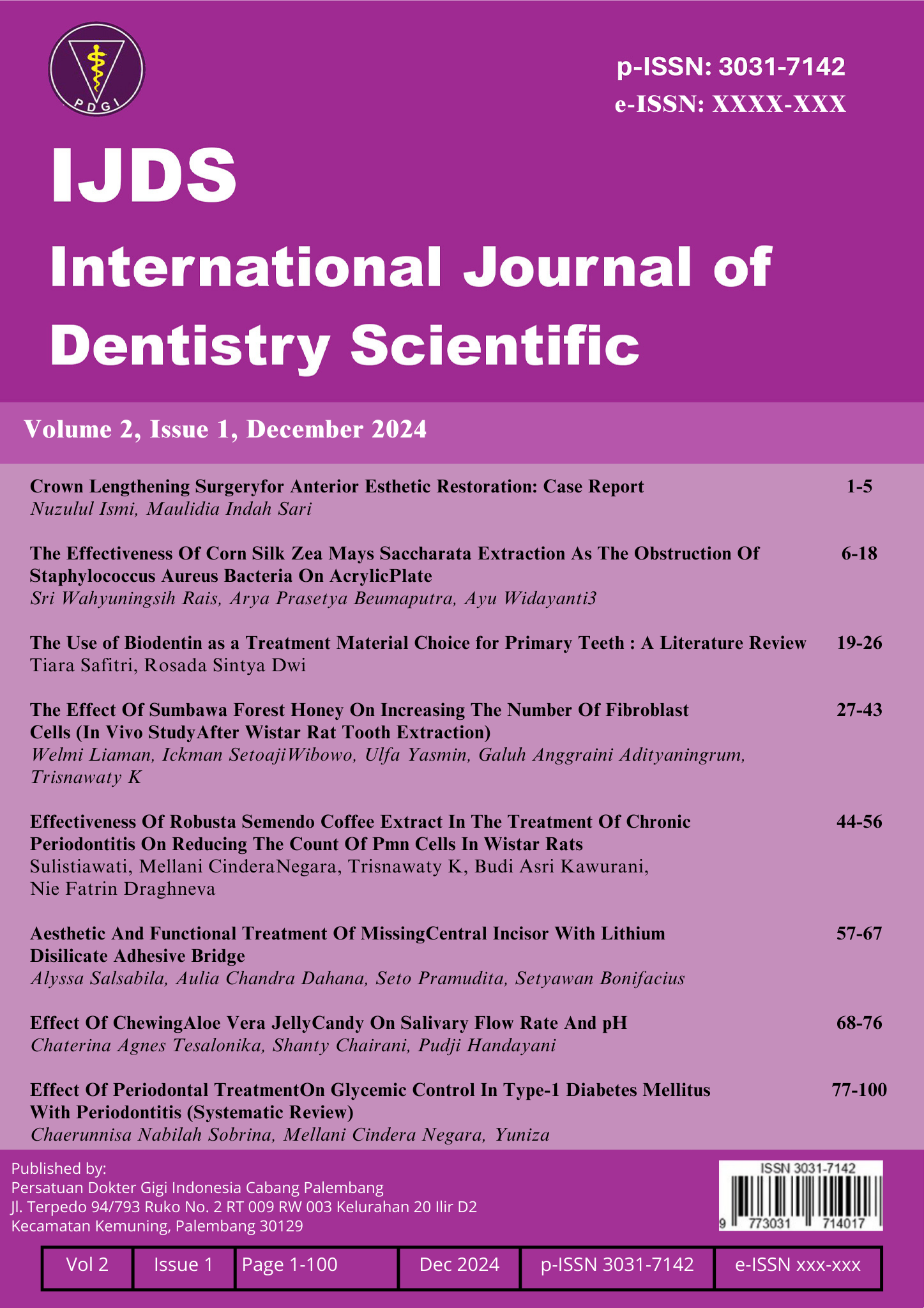
Aesthetic And Functional Treatment Of Missing Central Incisor With Lithium Disilicate Adhesive Bridge
Keywords:
Minimal Invasive, Adhesive bridge, lithium disilicateAbstract
Loss of anterior teeth is associated with aesthetic, phonetic, and functional disturbances. Due to the lower chewing load on the anterior teeth compared to the posterior teeth, a fixed partial denture with a lithium disilicate adhesive bridge can be a good alternative and compromise in this case with minimal invasive preparation, because it has better adhesive system, retention, strength, and aesthetics compared to metal material. To guarantee a strong long-term bonding, it is mandatory to perform adhesive procedures on enamel. Therefore, careful attention must be paid to guarantee that all margins and the tooth restoration interphase remain within the thickness of sound enamel. This case report aims to describe adhesive bridge treatment using lithium disilicate in cases of missing central incisor teeth. A 25-year-old female patient came to Padjadjaran University Dental Hospital (RSGM) with a chief complained of fractured central incisor with only the remaining mobility root or radix due to a previous accident and it caused aesthetic concerns as her job requires frequent interaction. The patient wanted to use a fixed denture without significant reduction of the adjacent teeth. After the remaining root or radix was extracted, the patient was inserted with a fixed denture using an adhesive bridge made of lithium disilicate material. Use of adhesive bridge dentures with lithium disilicate material for maxillary anterior teeth and provided satisfaction for patients because it can overcome aesthetic problems and improved good phonetic and masticatory functions.
References
Potdukhe S. All Ceramic Pressable Lithium Disilicate Maryland Bridge: A Case with Two-Year Follow-up. Journal of Clinical and Diagnostic Research. 2022.
Botelho MG, Chan AW, Leung NC, Lam WY.Long-term evaluation of cantilevered versus fixed-fixed resin-bonded fixed partial dentures for missing maxillary incisors. J Dent. 2016; 45:59-66.
Gulati JS, Tabiat-Pour S, Watkins S, Banerjee A. Resin-bonded bridges–the problem or the solution? Part 1: Assessment and design. Dent Update. 2016; 43(6):506-21.
Thoma DS, Sailer I, Ioannidis A, Zwahlen M, Makarov N, Pjetursson BE. A systematic review of the survival and complication rates of resin-bonded fixed dental prostheses after a mean observation period of at least 5 years. Clin Oral Implants Res. 2017; 28(11):1421-32
Abuzar M, Locke J, Burt G, Clausen G, Escobar K. Longevity of anterior
resin-bonded bridges: Survival rates of two tooth preparation designs. Aust Dent J. 2018; 63(3):279-84.
Balasubramanian GR. Predictability of resin bonded bridges - A systematic review. Br Dent J. 2017; 222(11):849-58
Alraheam IA, Ngoc CN, Wiesen CA, Donovan TE. Five-year success rate of resin bonded fixed partial dentures: A systematic review. J Esthet Restor Dent. 2019; 31(1):40-50.
Faris Y, der berghe V, Filiep R, Hugo De. A retrospective cohort study of metal-cast resin- bonded fixed dental prostheses after at least 16 years.Eur J Oral Implantol. 2013;6(1):1–10.
Pjetursson BE, Tan WC, Tan K, Brägger U, Zwahlen M, Lang NP. A systematic review of the survival and complication rates of resin-bonded bridges after an observation period of at least 5 years. Clin Oral ImplantsRes. 2008 Feb;19(2):131–41.
Rochette AL. Attachment of a splint to enamel of lower anterior teeth. J Prosthet Dent. 1973 Oct;30(4):418–23.
Denry I, Holloway J. Ceramics for Dental Applications: A Review.Materials. 2010 Jan 11;3(1):351–68.
Albakry M, Guazzato M, Vincent Swain M. Biaxial Flexural Strength and Microstructure Changes of Two Recycled Pressable Glass Ceramics. Journal of Prosthodontics. 2004 Sep 2;13(3):141–9.
Hin Beh Y, Ariffin A. Critical Evaluation of Failed Maxillary Resin Bonded: A Case Study. Journal of Dentistry Indonesia 2022;29. https://doi.org/10.14693/jdi.v29i2.1269.
Audenino G, Giannella G, Morello GM, Ceccarelli M, Carossa S, Bassi F. Resin-bonded fixed partial dentures: ten-year follow-up. Int J Prosthodont. 2006;19(1):22–3.
Sasse M, Kern M. CAD/CAM single retainer zirconia-ceramic resin-bonded fixed dental prostheses: clinical outcome after 5 years. Int J Comput Dent. 2013;16(2):109–18.
Alraheam IA, Ngoc CN, Wiesen CA, Donovan TE. Five-year success rateof resin-bonded fixed partial dentures: A systematic review. Journal of Esthetic
and Restorative Dentistry. 2019 Jan;31(1):40–50.
Sailer I, Bonani T, Brodbeck U, Hammerle C. Retrospective Clinical Studyof Single Retainer Cantilever Anterior and Posterior Glass-Ceramic Resin- Bonded Fixed Dental Prostheses at a Mean Follow-up of 6 Years. International Journal of Prosthodontics. 2013 Sep;26(5):443–50
Chen J, Cai H, Suo L, Xue Y, Wang J, Wan Q. A systematic review of the survival and complication rates of inlay-retained fixed dental prostheses. J Dent. 2017 Apr; 59:2–10.
Bekhiet, M., taymour, maha, & Zamzam, M. Clinical Evaluation and Patient Satisfaction of Shade Matching Between Natural Teeth and Monolithic All- Ceramic Crowns Fabricated from Two Materials (Randomized Controlled Clinical Trial). Egyptian Dental Journal. 2021. 67(3), 2231–2238. https://doi.org/10.21608/edj.2021.62512.1495.
Handoko, S. A. Laporan Kasus Pembongkaran Gigi Tiruan Cekat (GTC) Pasca Kegagalan Perawatann Perawatan. 2018.
Downloads
Published
Issue
Section
License

This work is licensed under a Creative Commons Attribution-NonCommercial-ShareAlike 4.0 International License.
CC Attribution-NonCommercial-ShareAlike 4.0