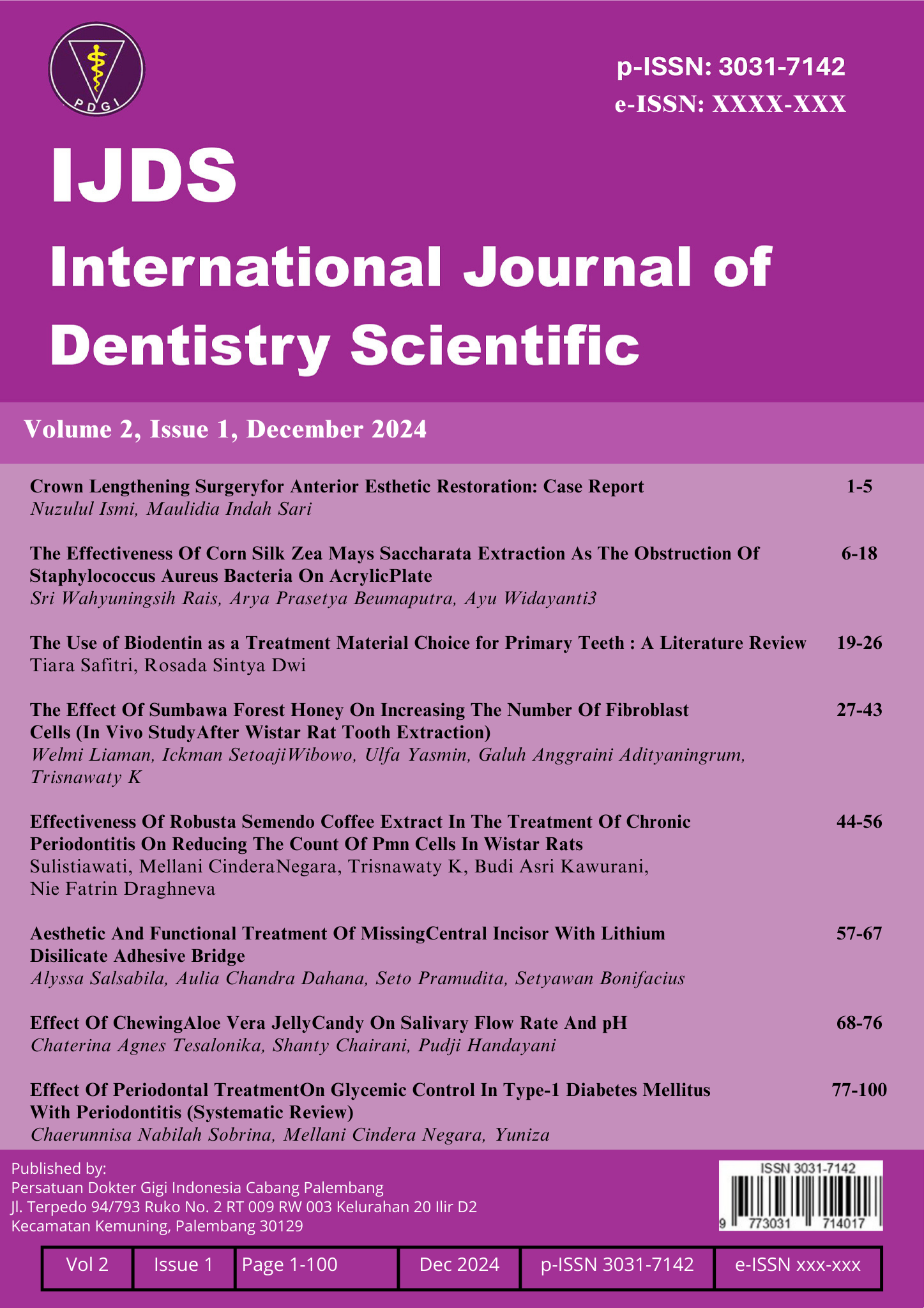
The Effectiveness Of Corn Silk Zea Mays Saccharata Extraction As The Obstruction Of Staphylococcus Aureus Bacteria On Acrylic Plate
Keywords:
Staphylococcus aureus, RPD, Corn silk Zea mays SaccharataAbstract
Staphylococcus aureus is one of the bacteria that contribute to plaque formation and is often found on the surface of acrylic plates on removable partial dentures (RPDs). RPD cleaning can be done mechanically, chemically, or in combination. Sweet corn silk (Corn silk Zea mays Saccharata) can be used as an alternative natural ingredient for RPD cleaners because Corn silk Zea mays Saccharata contains flavonoids, saponins, and alkaloids that can act as antibacterials. Purpose: This study aims to determine the effect of Corn silk Zea mays Saccharata extract in inhibiting the growth of Staphylococcus aureus bacteria on acrylic plates. Materials and Methods: This study used sweet corn silk with laboratory experimental research type using a post-test only control group design approach. The maceration method using 70% ethanol solvent was carried out to make Corn silk Zea mays Saccharata extract and then diluted to obtain concentrations of 25%, 50%, and 75%. This study used 0.5% Sodium Hypochlorite as the positive control and aquades as the negative control. Results: The lowest average growth of Staphylococcus aureus bacteria on acrylic plates was when Corn silk Zea mays Saccharata was given at 75%, which was 366.40 CFU/ml, but not as low as Sodium Hypochlorite, which was 0 CFU/ml. While the highest average growth of Staphylococcus aureus bacteria on acrylic plates was the negative control at 1196.80 CFU/ml. Conclusion: Corn silk Zea mays Saccharata extract using ethanol solvent can inhibit the growth of Staphylococcus aureus bacteria on acrylic plates with 75% as the concentration that has the highest level of effectiveness.
References
Setiawan R. Relining Management on Removable Partial Dentures (RPD). Widya Scientific Journal. 2013;1(1):60–4.
Costa de Medeiros Dantas L, Paulo da Silva-Neto J, Souza Dantas T, Zago Naves L, Domingues das Neves F, Soares da Mota A. Bacterial adhesion and surface roughness for different clinical techniques for acrylic polymethyl methacrylate. Int J Dent. 2016;2016:1–6.
Pereira CA, Toledo BC, Santos CT, Pereira Costa ACB, Back-Brito GN, Kaminagakura E, et al. Opportunistic microorganisms in individuals with lesions of denture stomatitis. Diagn Microbiol Infect Dis. 2013;76(4):419–24.
Lahama L, Wowor VNS, Waworuntu OA. Denture Stomatitis in Denture Users in Batu Village, Manado City. Pharmacon. 2015;4(4):71–81.
Sofya PA, Rahmayani L, Fatmawati F, Bahan A. Level of Cleanliness of Acrylic Resin Removable Partial Dentures Reviewed from the Frequency and Cleaning Method. Journal Of Syiah Kuala Dentistry Society. 2016;1(1):91–5.
Arruda CNF, Sorgini DB, de Oliveira VC, Macedo AP, Lovato CHS, de Paranhos HFO. Effects of denture cleansers on heat-polymerized acrylic resin: A five-year-simulated period of use. Braz Dent J. 2015;26(4):404–8.
Salles MM, Badaró MM, de Arruda CNF, Leite VMF, da Silva CHL, Watanabe E, et al. Antimicrobial activity of complete denture cleanser solutions based on sodium hypochlorite and Ricinus communis – A randomized clinical study. Journal of Applied Oral Science. 2015;23(6):637–6342.
Trisnawaty Habi U, Limonu M, Tahir M, Department of Food Science and Technology M, Agriculture F, Gorontalo State University, et al. Chemical Test of Corn Silk Herbal Powder Formulated with Cinnamon Powder (Cinnamomum burmannii). Vol. 3, Jambura Journal of Food Technology (JJFT). 2021:50-61.
Sarepoua E, Tangwongchai R, Suriharn B, Lertrat K. Influence of variety and harvest maturity on phytochemical content in corn silk. Food Chem [Internet]. 2015;169:424–9. Available
from:http://dx.doi.org/10.1016/j.foodchem.2014.07.136
Selim Morshed SMSI. Antimicrobial Activity and Phytochemical Properties of Corn (Zea mays L.) Silk. SKUAST J Res. 2016;17(January 2015):8–14.
Haslina H, Untari S. Effect of Extraction Time and Corn Silk Extract Concentration on pH, Total Phenol and Antibacterial Activity. Journal of Engineering and Technology Development. 2018;13(2):58.
Jaelani IM, Sari WP, Fadriyanti O. The effect of the amount of non-dental glass fiber in reinforced acrylic resin (polymethyl methacrylate) on the
attachment of Candida albicans Intan. Journal of Dentistry, Padjadjaran University. 2019;31(2):155–9.
Rahman E. Effectiveness of the extract of the leaves of the gods. Faculty of Dentistry UNISSULA. 2010;1–13.
Perawati S, Andriani L, Pratiwi P. Antibacterial Activity of Ethanol Extract of Creeping Plant Leaves (Mikania micrantha Kunth). Chempublish Journal. 2018;3(2):40–5.
Soleha TU, Apriliana E, Ayu W, H, Normal F, Mouth R, et al. Differences in the Number of Normal Oral Flora in the Elderly and Adults Who Have Received Antibiotic Treatment in Bandar Lampung. 2017:154-8.
Estrela C, Estrela CRA, Barbin EL, Spanó JCE, Marchesan MA, Pécora JD. Mechanism of action of sodium hypochlorite. Braz Dent J. 2002;13(2):113–7.
Tiara Y, Alwi M, Musjaya D, Gulli M, Biology J, Mathematics F, et al. Identification of Normal Flora Bacteria of Nasal Mucosa and Salive in Gold Miners (Tromol) in Poboya Village, East Palu District, Central Sulawesi. Vol. 8, Biocelebes Journal. 2014:10-6.
Etica U, Mahmudah D, Universitas H, Gontor D, Timur PJ. Cropping Pattern of Circle-lined Row to Increase Population and Production in Sweet Corn (Zea mays-Saccharata) [Internet]. Available from:http://jurnal.unmuhjember.ac.id/
Syawal AN, Laeliocattleya RA. Potential of Corn Hair Herbal Tea (Zea mays L.) as a Source of Antioxidants: Literature Review. Journal of Food Science and Agricultural Products. 2020 Sep 14;4(1):1–6.
Asrori MRSHWW. Methanol and Ethanol: Production, Characterization, Exploration, and Empowerment of Natural Resources. 2020;179–91.
Jusuf MI. Methanol Intoxication. 2010;vol.5:290–392.
Downloads
Published
Issue
Section
License

This work is licensed under a Creative Commons Attribution-NonCommercial-ShareAlike 4.0 International License.
CC Attribution-NonCommercial-ShareAlike 4.0